Today is Boxing Day. For those who are not acquainted with this holiday, it is not a day of celebration of the sport of boxing, but rather a day where everyone takes the presents they received on Christmas and returns them to the store and tries to exchange them for something more desirable to the recipient.
In our continuing series on Future-Proofing, I asked an important question last time: When are YOU getting out of the bot business? First, let’s go over why this is an important question:
Last time I said that successful people answer questions long before other people consider asking them. Successful people know when they are going to leave a job before they accept the position. Successful people know when they are going to sell a car, stock, etc before it is purchased. When bidding for auctions, successful people know how much they ultimately will bid. Impulse buyers get caught in the hype and bid emotionally. The same principle applies to businesses. Successful people know when they are going to leave the business before they decide to start one.
But when most of us got into this, we were not thinking that way. When I started, YATbot was the bot I used. I got into the bot business as a way to get cards so that I would not have to purchase them from bots or WotC. In this manner, I could continue to play the game without spending any currency. If I made a profit, well, that was a nice bonus.
Turns out that bonus from YATbot was enough to expand to have multiple copies running and grew enough to make a nice little part time business out of it.
When MTGO v3 came out and it became apparent that YATbot would not be upgraded, instead of simply trying to sell off my inventory for pennies on the ticket, like so many others were doing, I decided to find another bot program, MTGO Library is what I settled on and I am glad found it.
That’s all well and good, but what does this tell us about when to quit the bot business?
This incident told me that I was willing to fight to stay in this business. Which means that I am not going to want to give this up any time soon.
But I have since drawn up a succession plan. My wife can run this business. If my kids get interested, I could pass off this business to them. If I wanted to sell, I know a few people who could be interested in learning about this business and I could unload that way. In a sense, this business could go on, even if I am not around to do anything about it. But that hinges on one final thing, and on that, we will conclude this series on Future-Proofing, next time.
Showing posts with label Yatbot. Show all posts
Wednesday, December 26, 2012
Future Proofing: Selling (Part 2 of 2)
Friday, March 30, 2012
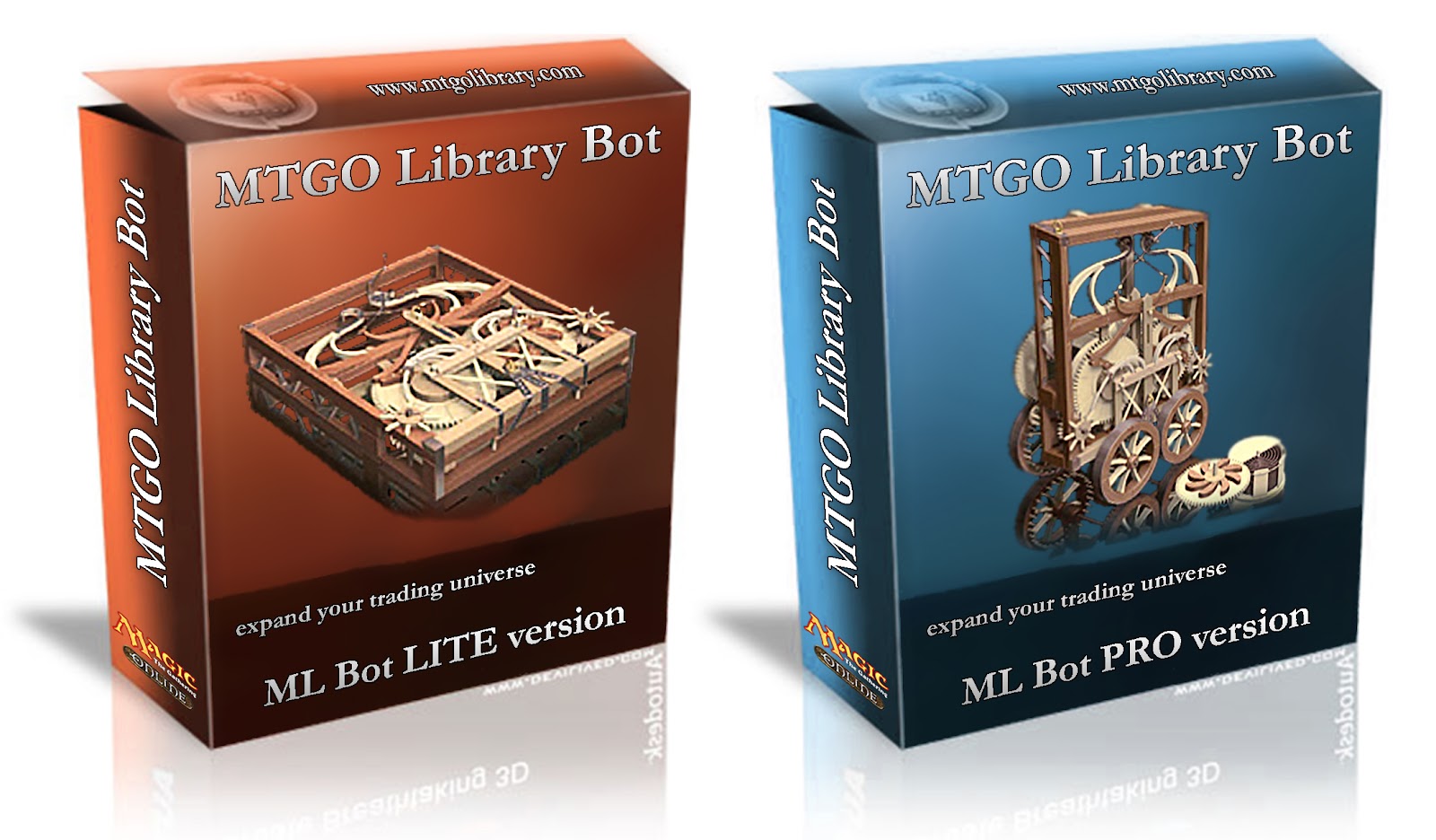
Pro Vs Lite
The only difference between Pro and Lite versions of ML Bot is the pricing system.
The Lite bot will let you choose a unique price for "category". For example, all the common foils will cost 0.5 tixs, all the regular mythics will cost 2 tixs (and so on). There are 20 categories of cards.
The Pro bot uses instead a pricelist, and prices each card it own "real" price. For example Flameshot will cost 0.080 and Rhystic Scrying 0.073.
The Lite bot will let you choose a unique price for "category". For example, all the common foils will cost 0.5 tixs, all the regular mythics will cost 2 tixs (and so on). There are 20 categories of cards.
The Pro bot uses instead a pricelist, and prices each card it own "real" price. For example Flameshot will cost 0.080 and Rhystic Scrying 0.073.
Labels
botting,
configuration,
design,
questions; answers,
Yatbot
Sunday, March 18, 2012
LITE Bot Sell 1:200, Buy 1:300
One of the basic question I get often get is: "how do I tell the bot to sell 200 commons for 1 tix, and buy 300 for 1"?The answer is that you have to use the LITE Bot and set the proper prices in the "Prices Tab". In particular, you need to set the selling price for the commons to 0.005 (because 1 tix divided by 200 equals 0.005) and the buying price to 0.003 (1 tix divided by 300 would be 0.0033, but ML Bot round the value to 0.003)
Tuesday, September 13, 2011
When to Cash Out (Part 7)
Last time I discussed my attempts at writing my own MTGO bot and the difficulties which lie therein and how my failure to plan for the contingency of YATBot 3 not being created cost me profits while my inventory gathered virtual dust.
After I had given up my pursuit of writing my own bot, I began to ponder what to do next. Did I want to sell off my inventory and walk away, or did I want to seek out another bot?
This decision was fairly an easy one to make. EBay was being inundated with collection auctions and some auctions were pretty much being given away. Since this created a massive glut, I knew that my collection would not bring fair market value and holding onto the collection would not help matters any. If anything, this was the perfect time to gobble up all this inventory but I had no plans or available monies to take advantage of this fact. So the search began for a replacement bot and slightly lamented over this missed opportunity.
I came upon MTGO Library and have been pleased ever since. It had all of YATBot's features and so much more. I could even run one bot and have MTGO Library handle all the cards, so I began the process of transferring all the inventory to a single account.
I also began to conceive of a way to measure the effectiveness of MTGO Library. Under YATBot, I had a spreadsheet which showed the number of trades and the number of cards traded were tracked. I let my wife handle this bookkeeping details and once a week I looked at the progress. I could tell you how many cards in profit each of the bots were bringing in. Obviously the commons would give me more cards than rares, but beyond that, it was difficult to explain to non MTGO people what my profit margin was, how much money the bots were making on paper and even more importantly, how much cash in hand I was actually receiving.
We'll get into how MTGO Library solved this problem next time.
After I had given up my pursuit of writing my own bot, I began to ponder what to do next. Did I want to sell off my inventory and walk away, or did I want to seek out another bot?
This decision was fairly an easy one to make. EBay was being inundated with collection auctions and some auctions were pretty much being given away. Since this created a massive glut, I knew that my collection would not bring fair market value and holding onto the collection would not help matters any. If anything, this was the perfect time to gobble up all this inventory but I had no plans or available monies to take advantage of this fact. So the search began for a replacement bot and slightly lamented over this missed opportunity.
I came upon MTGO Library and have been pleased ever since. It had all of YATBot's features and so much more. I could even run one bot and have MTGO Library handle all the cards, so I began the process of transferring all the inventory to a single account.
I also began to conceive of a way to measure the effectiveness of MTGO Library. Under YATBot, I had a spreadsheet which showed the number of trades and the number of cards traded were tracked. I let my wife handle this bookkeeping details and once a week I looked at the progress. I could tell you how many cards in profit each of the bots were bringing in. Obviously the commons would give me more cards than rares, but beyond that, it was difficult to explain to non MTGO people what my profit margin was, how much money the bots were making on paper and even more importantly, how much cash in hand I was actually receiving.
We'll get into how MTGO Library solved this problem next time.
Friday, September 9, 2011
When to Cash Out (Part 6)
In our continuing series of When to Cash Out, we are discussing a test case, namely myself. I had given a history until MTGO 3.0 came out. I waited around for YATBot 3 to come out and became dissuaded when it became apparent that there would be no YATBot 3 coming out anytime soon.So, being an amateur programmer, I decided to try and write my own YATBot. Since I have a full time job, this would have to be literally a weekend project.
So I began a schedule of tweaking routines during the week and getting new routines done during the weekend. This was quite difficult as I needed two (2) computers running MTGO. While it is true I could have used VMware for this, I needed to see how my bot would appear from a customer's perspective.
So I wrote a login routine and that worked. I wrote an initial trade request and that worked. I even got the bot to acknowledge the customer by name and could even have custom messages sent to the individual customer. A neat little feature I thought. Since I was using YATBot as a guide, I attempted to program my bot like YATBot. So a customer had to enter which rarity they wanted to select. I got the picking of the cards down. In short, I was making good progress.
But my wife had a baby. My employer canceled my paternity leave. So time to work on the bot was decreasing. So progress was slowing down. People had already given up on YATBot 3.0 being released. I too was secretly hoping it would be released as this bot was taxing my skill set.
The kicker though was what WotC did: They decided to hamper development of bots by moving the message window around the screen from trade to trade. Yes, I was able to discern the pattern of where the chat box would be, but it also told me that one simple little change could wreck my bot. If the change occurred early in the week, I would be unable to make changes, even assuming I could, until I had sufficient time to repair the bot. By the way, this week's EULA screen change would not have helped matters.
Let this be a lesson: I had failed to plan for the contingency of YATBot 3.0 not being created. As a result, several months were lost with idle inventory and lost profits.
However, I did find MTGO Library and that was a smart business move. We'll go into those happy details next time.
Tuesday, September 6, 2011
When to Cash Out (Part 5)
Today we are continuing our series on when to cash out. The answer to that question depends greatly on your future plans. (Remember, failure to plan equates planning to fail.) We are going to examine one case, namely myself.I started playing Magic back when Tempest was newly released. I was in a WotC store and managed to acquire a beta copy of MTG:O and was an active beta-tester. When MTG:O was released, I was house hunting and knew that I was going to be unable to participate in both physical cards and virtual cards. That's when I began seeking ways to continue to play Magic with present and future cards without digging too deep into our pockets when things like mortgages and auto insurance are more important.
That's when I found YATBot. I had a spare computer and dedicated it to running an Uncommon version of YATBot. I studied the market and realized that uncommons were an under-served market and thought I could use that to get decent playable cards. It worked quite well, and even made some pocket money on the side in addition to obtaining more cards to make reasonably competitive decks.
Then I discovered that VMware because a free product and a friend had a computer with a newly burnt out video card slot. It was not going to play Crysis, but it was able to run VMware with two (2) bots on it comfortably. So, I decided to forgo some profits and purchase an additional two (2) licenses of YATBot and run two (2) bots on this secondhand computer and the original was being run in a VM under my desktop.
This setup worked quite well. My profits increased. I was getting quicker access to cards so I was able to compete sooner than I was in the past. Until MTGO 2.x's limit was reached and I was forced to drop down to one bot at a time and then waiting around until YATBot 3.0 would be released.
We'll continue this next time.
Subscribe to:
Posts (Atom)